
Mixed Air and ERV/HRV Processes on a Psychrometric Chart
This practical training page explains how outdoor air, return air, mixed air, and energy recovery ventilation interact on a psychrometric chart in HVAC design.
This topic is especially useful for ventilation load review, ERV/HRV effectiveness interpretation, mixed air condition estimation, and evaluating how energy recovery reduces cooling and heating loads before the coil.
Psychrometric Chart Showing ERV/HRV Process
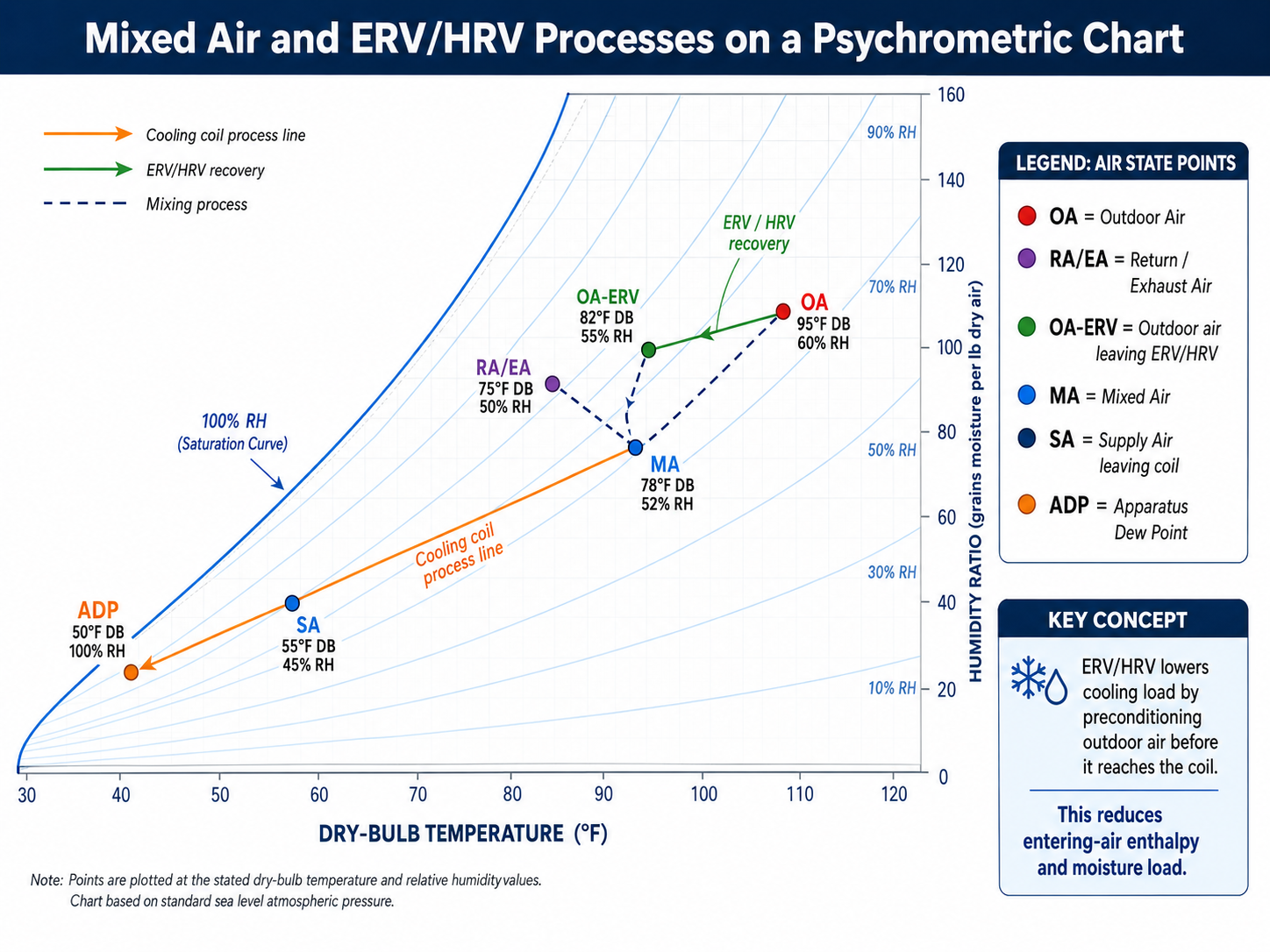
This chart shows how the ERV/HRV process shifts outdoor air toward a more favorable condition before it reaches the cooling or heating coil.
The result is lower ventilation load, reduced coil demand, and improved system efficiency.
What ERV and HRV Mean
An HRV (Heat Recovery Ventilator) transfers primarily sensible heat between exhaust air and outdoor air.
An ERV (Energy Recovery Ventilator) transfers both sensible heat and part of the latent energy, depending on the core type and operating conditions.
In cooling season, an ERV can reduce both outdoor air dry-bulb temperature effect and part of the outdoor air moisture load before the air reaches the cooling coil.
In heating season, the ERV/HRV can preheat outdoor air and reduce heating demand.
Why This Process Matters in HVAC Design
- It reduces the outdoor air load before the main coil.
- It helps estimate the actual air condition entering the cooling or heating coil.
- It improves ventilation efficiency without increasing coil capacity unnecessarily.
- It supports better equipment selection and more realistic load calculations.
- It helps explain why ERV/HRV systems can reduce operating cost and improve comfort.
Key Air States on the Psychrometric Chart
- OA – Outdoor Air: the ventilation air entering the system from outdoors.
- RA – Return Air: air returning from the conditioned space.
- MA – Mixed Air: the condition created when outdoor air and return air mix.
- SA – Supply Air: air delivered to the space after passing through the HVAC process.
- ERV/HRV Leaving Air: outdoor air condition after energy recovery.
Basic Practical Interpretation
Without ERV/HRV, outdoor air may enter the mixing box or coil at a high temperature and humidity condition.
With ERV/HRV, that outdoor air is shifted toward the exhaust or return air condition, depending on effectiveness.
This means the coil no longer handles the full outdoor air load directly.
On the psychrometric chart, this is shown as a process line from the outdoor air point toward a more moderate leaving-air condition.
That shifted condition can then be mixed with return air or sent toward the cooling coil, resulting in a smaller coil load.
Sensible Effectiveness Formula
Leaving OA Dry-Bulb Temperature:
Tleaving = TOA – εs × (TOA – TRA)
where:
- TOA = outdoor air dry-bulb temperature
- TRA = return or exhaust air dry-bulb temperature
- εs = sensible effectiveness
Approximate Sensible Load Reduction
Q = 1.08 × CFM × ΔT
The reduction in outdoor air sensible load can be estimated by comparing the coil entering temperature
with and without ERV/HRV preconditioning.
Latent / Moisture Recovery Concept
For ERV systems, some moisture transfer may also occur. This reduces the humidity ratio of incoming outdoor air in cooling season
and reduces the dehumidification work required from the cooling coil.
In practical design review, the main goal is to confirm whether the ERV leaving air condition significantly reduces the total ventilation load
and whether the benefit is already accounted for in the equipment selection.
Common Practical Design Checks
- Check whether the ERV/HRV effectiveness used in calculations matches the manufacturer data.
- Confirm whether the selected leaving air condition is realistic for the design outdoor and return conditions.
- Verify whether the reduced OA load has already been included in the coil or indoor unit selection.
- Review whether frost, bypass, wheel control, or economizer operation may change the actual effectiveness.
- Make sure the psychrometric process shown matches the actual system sequence.
Example Design Interpretation
If outdoor air enters at a hot and humid condition, and the ERV shifts it closer to return air conditions before it reaches the coil,
the resulting mixed air or coil entering air condition will be less severe. This directly reduces the ventilation cooling load and may reduce
the required coil capacity or help improve coil leaving condition margin.
Final Practical Note
ERV/HRV analysis should not only be treated as a theoretical psychrometric exercise. In real projects, it helps answer practical questions:
How much outdoor air load is being reduced? Is the cooling coil receiving already-preconditioned air? Has this benefit been included in the unit selection? And is the final supply air condition still sufficient for the space load?