
Room Sensible Heat Ratio and Supply Air Condition
This practical training page explains how room sensible heat ratio connects room sensible load, latent load, supply air temperature, and psychrometric process lines in HVAC design.
This topic is useful for engineers and designers who need to estimate supply air conditions and understand whether the selected air condition can satisfy both sensible and latent room loads.
What Room Sensible Heat Ratio Means
Video Explanation
This video explains the difference between the room process/RSHR line and the cooling coil process line on a psychrometric chart.
Room Sensible Heat Ratio, or RSHR, is the ratio of room sensible heat to room total heat. It describes the relationship between the sensible and latent portions of the room load.
RSHR = Room Sensible Heat / Room Total Heat
Room Total Heat is the sum of room sensible heat and room latent heat.
RTH = RSH + RLH
Why RSHR Matters
- It helps define the room process line on the psychrometric chart.
- It shows the relationship between temperature reduction and moisture removal.
- It helps evaluate whether a supply air condition can satisfy the space load.
- It is useful when reviewing cooling coil leaving air conditions.
- It helps identify whether latent load is being ignored or underestimated.
Estimating Supply Air Temperature
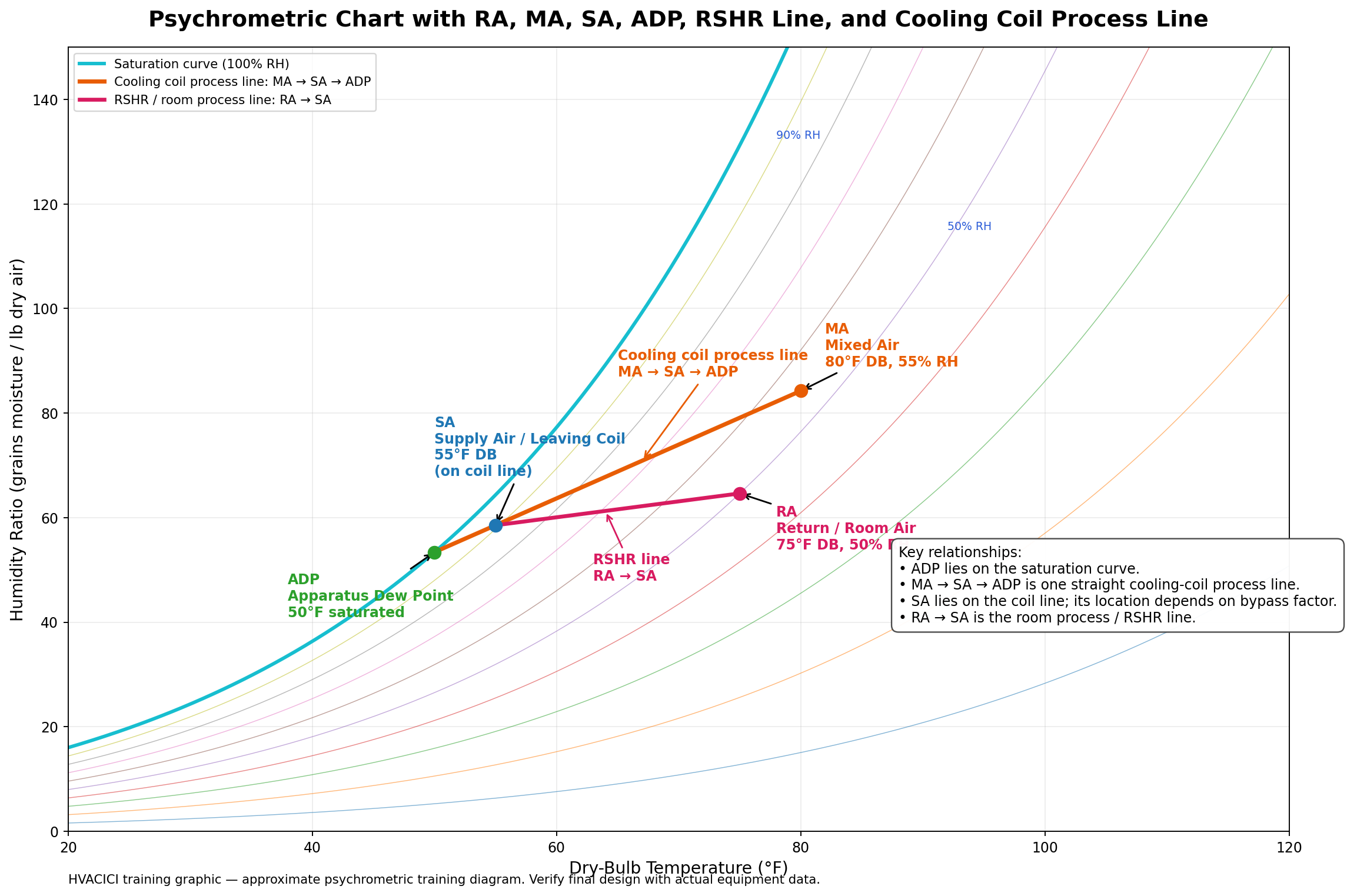
This chart shows the relationship between the room process/RSHR line and the cooling coil process line. The magenta line connects return/room air (RA) to supply air (SA), while the orange line represents the cooling coil process from mixed air (MA) through supply air (SA) toward the apparatus dew point (ADP) on the saturation curve.
A common practical method is to estimate supply air temperature from room sensible load and supply airflow.
RSH = 1.08 × CFM × (Troom − Tsupply)
Rearranged:
Tsupply = Troom − RSH / (1.08 × CFM)
Important Humidity Check
After estimating supply air temperature, the supply air humidity ratio should also be checked. A supply air dry-bulb temperature alone does not fully define the air condition.
If the required supply air humidity ratio is lower than what is realistic at the selected supply air temperature, the designer may need to review coil leaving air condition, airflow, apparatus dew point, bypass factor, or supply air temperature assumptions.
Room Process Line vs. Coil Process Line
- Room process line: connects the room condition and supply air condition based on room sensible and latent loads.
- Coil process line: connects entering coil air condition and leaving coil air condition based on cooling coil performance.
- These two process lines are related but not always the same.
- Confusing them can lead to incorrect supply air or coil selection assumptions.
Practical Example
Assume the following room conditions:
- Room sensible load = 24,000 Btu/hr
- Room latent load = 6,000 Btu/hr
- Room temperature = 75°F
- Supply airflow = 1,000 CFM
Step 1: Calculate room total heat
RTH = 24,000 + 6,000 = 30,000 Btu/hr
Step 2: Calculate RSHR
RSHR = 24,000 / 30,000 = 0.80
Step 3: Estimate supply air temperature
Tsupply = 75 − 24,000 / (1.08 × 1,000)
Tsupply ≈ 52.8°F
Common Engineering Mistakes
- Using supply air temperature without checking humidity ratio.
- Assuming sensible-only cooling when latent load is present.
- Confusing room sensible heat ratio with coil sensible heat ratio.
- Ignoring outdoor air latent load in commercial projects.
- Using RSHR as a chart line without understanding the actual supply air condition.
Video Status
A step-by-step YouTube training video will be added here to show how to draw the RSHR line and estimate supply air condition on a psychrometric chart.