
Mixed Air and ERV/HRV Processes
This practical training page explains how outdoor air, return air, mixed air, and ERV/HRV leaving air conditions affect HVAC coil loads and psychrometric process analysis.
This topic is useful for engineers and designers reviewing ventilation load, mixed air condition, heat recovery impact, cooling coil entering condition, and outdoor air latent load in commercial HVAC systems.
Psychrometric Chart Showing ERV/HRV Process
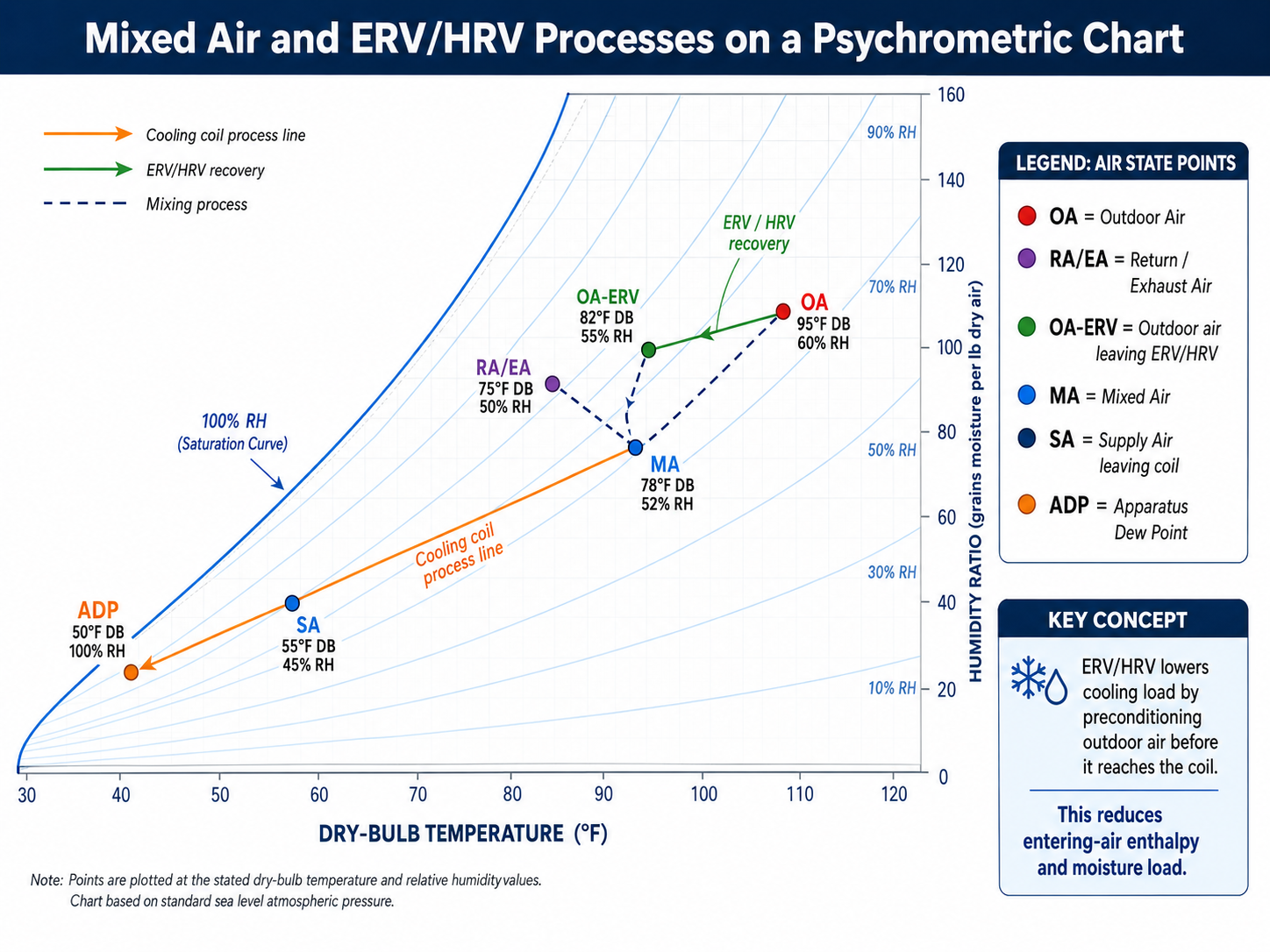
This chart shows how the ERV/HRV process shifts outdoor air toward a more favorable condition before it reaches the cooling or heating coil.
The result is lower ventilation load, reduced coil demand, and improved system efficiency.
Why Mixed Air Matters
In many commercial HVAC systems, outdoor air is introduced for ventilation and mixed with return air before entering the cooling or heating coil. The resulting mixed air condition can significantly affect coil capacity, latent load, supply air condition, and equipment selection.
Common Air Conditions
- Outdoor Air (OA): fresh air brought into the HVAC system for ventilation.
- Return Air (RA): air returning from the occupied space.
- Mixed Air (MA): the combined condition after OA and RA mix.
- ERV/HRV Leaving Air: outdoor air condition after heat recovery.
- Coil Entering Air: the air condition entering the cooling or heating coil.
Mixed Air Temperature Formula
Mixed Air Temperature:
TMA = (CFMOA × TOA + CFMRA × TRA) / (CFMOA + CFMRA)
Mixed Air Humidity Ratio Formula
Mixed Air Humidity Ratio:
WMA = (CFMOA × WOA + CFMRA × WRA) / (CFMOA + CFMRA)
The mixed air point on the psychrometric chart is located on a straight line between the outdoor air and return air conditions, weighted by the airflow ratio.
ERV/HRV Leaving Air Temperature
When an ERV or HRV is used, the outdoor air condition entering the air system may be modified before it reaches the coil.
Sensible Recovery Formula:
Tleaving OA = TOA + Effectiveness × (TRA − TOA)
In cooling mode, the ERV/HRV can reduce the outdoor air temperature before the cooling coil. In heating mode, it can preheat the outdoor air before the heating coil.
Why This Matters in Design
- Outdoor air can create a large cooling or heating load.
- Latent load from outdoor air may control coil selection in humid climates.
- ERV/HRV performance can reduce ventilation load before the coil.
- Mixed air condition affects coil entering air temperature and humidity ratio.
- Designers should avoid assuming outdoor air is already accounted for unless the equipment selection clearly includes it.
Practical Example
Assume:
- Outdoor air = 300 CFM at 90°F
- Return air = 900 CFM at 75°F
- Total supply airflow = 1,200 CFM
Mixed Air Temperature:
TMA = (300 × 90 + 900 × 75) / 1,200
TMA = 78.75°F
Common Engineering Mistakes
- Ignoring outdoor air latent load.
- Using dry-bulb temperature only and not checking humidity ratio.
- Assuming ERV/HRV benefit without checking actual effectiveness.
- Confusing mixed air condition with room condition.
- Using room sensible heat ratio to represent coil entering air behavior.
- Forgetting that the coil process line starts from the coil entering air condition, not necessarily the room condition.
Video Status
A step-by-step YouTube training video will be added here to show how to plot outdoor air, return air, mixed air, ERV/HRV leaving air, and coil process relationships on a psychrometric chart.